Huang’s franchise ran on three things: a supply chain locked years ahead, a balance sheet lent to Nvidia’s own customers, and deals struck between chief executives. Each is in a different state.
The supply chain
The supply chain is the most locked of the three. Nvidia has dated products out to 2028, and the first half of that map is in production.
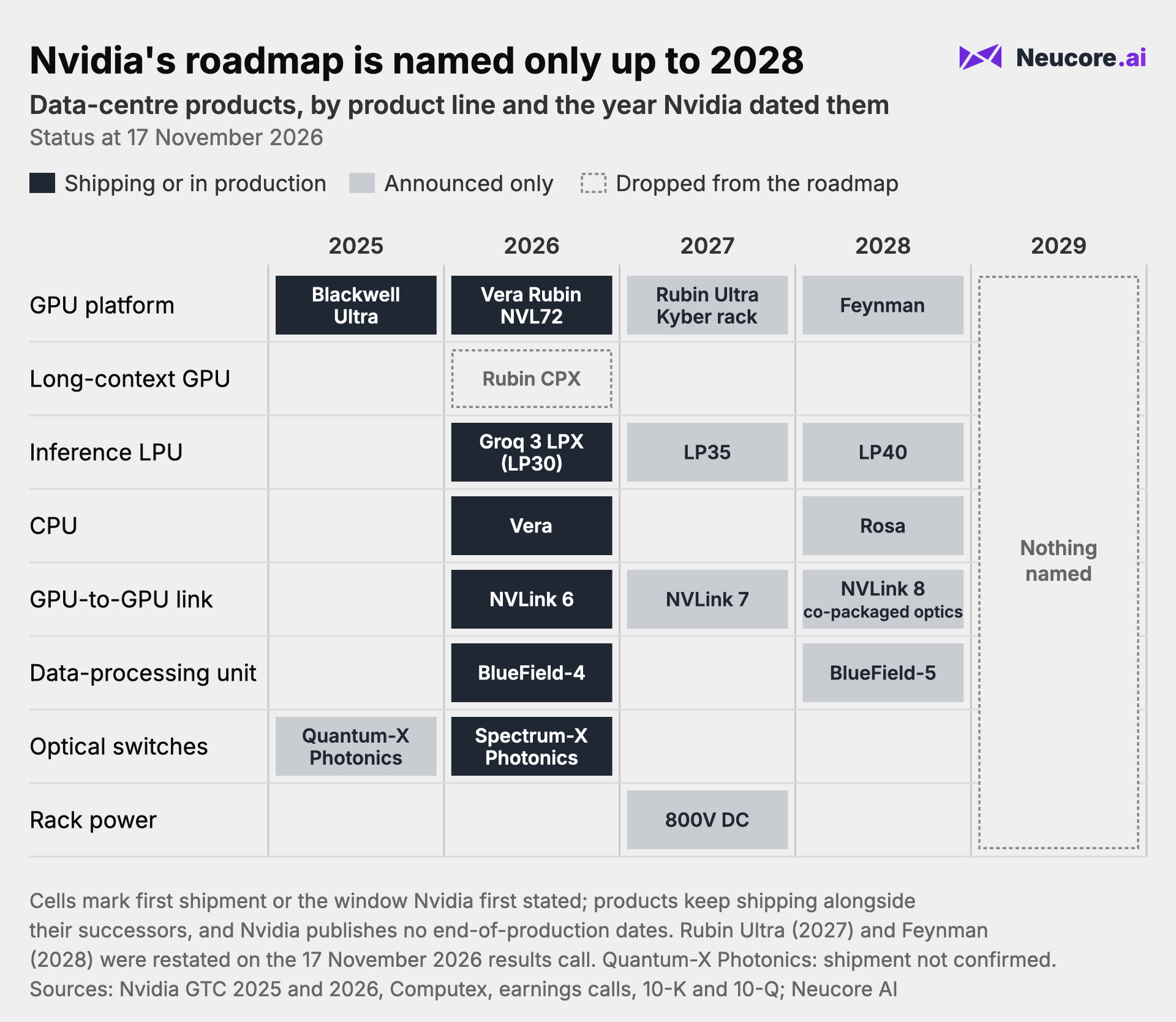
Blackwell Ultra has shipped in volume since mid-2025. Vera Rubin began production shipments in the October quarter and is in racks at CoreWeave, Google Cloud, Microsoft Azure, Oracle and Nebius. The Vera CPU, NVLink 6, BlueField-4, Spectrum-X Photonics and the Groq 3 LPX inference rack are all shipping or in full production. Everything dated 2027 or 2028 exists as a keynote slide: Rubin Ultra and the Kyber rack in 2027, Feynman with the Rosa CPU in 2028. Rubin CPX, dated end-2026 a year ago, no longer appears. Since the Blackwell delay of 2024, each generation has met or beaten the half-year window Nvidia gave for it.
Behind the products sits the supply book. Supply and capacity commitments rose to $390bn in October, from $119bn six months earlier; Nvidia attributes the latest increase mainly to multi-year memory. “We’ve secured memory, we’ve secured advanced packaging,” interim chief executive Colette Kress said on the call. 93% of the book falls due by January 2029. After that the schedule runs to $26bn, and nothing has been named for 2029.
The vendor financing
The second thing Huang built is a balance sheet that finances Nvidia’s own customers. Our ledger counts 27 commitments with a disclosed dollar amount, each tied to a filing or a named release, updated for the October quarter.
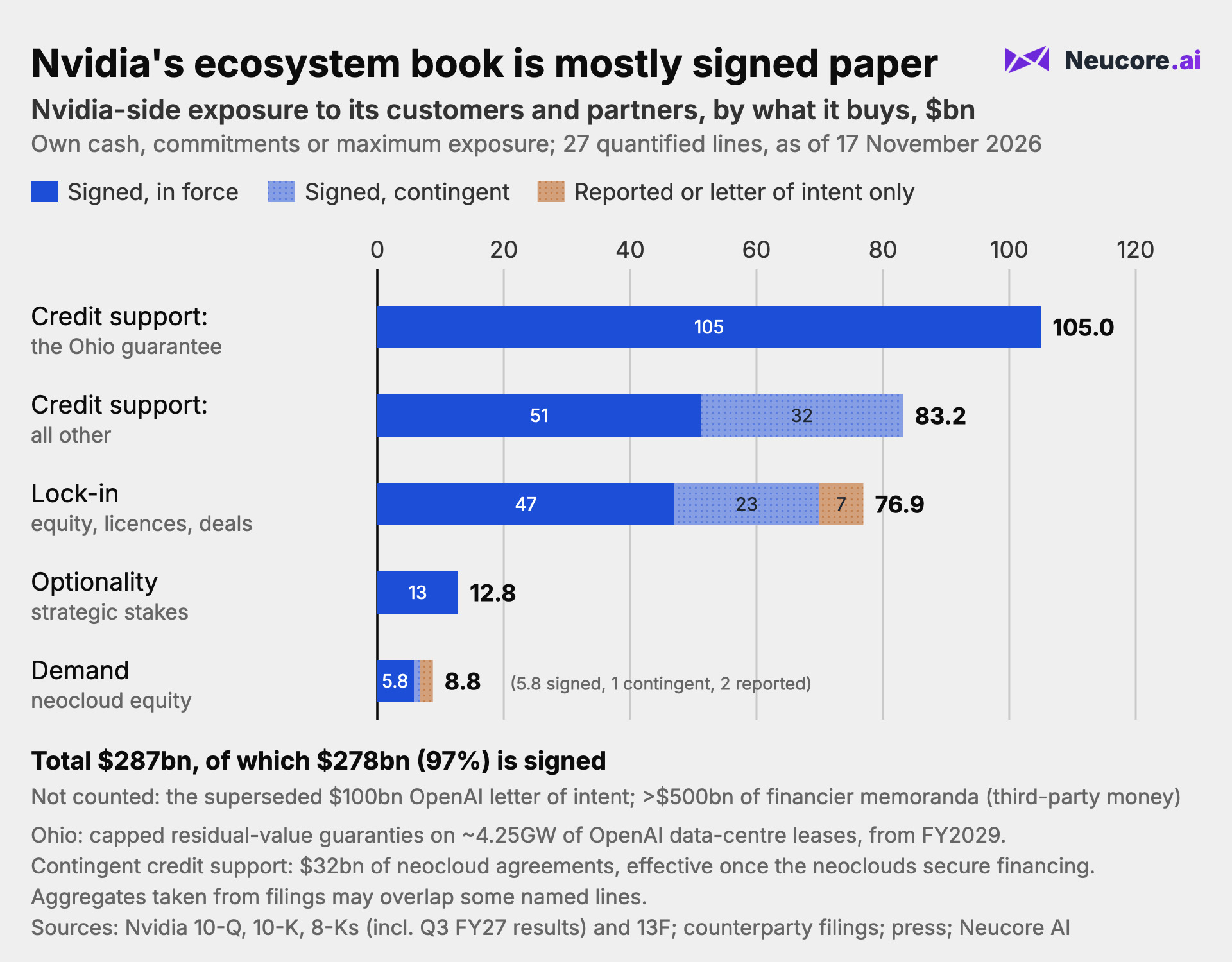
- Most of it is credit. Two-thirds of the $287bn is guarantees, backstops and capacity Nvidia has agreed to buy back, led by the $105bn guarantee on OpenAI’s leases in Ohio. Nvidia underwrites its customers’ build-out as well as selling into it.
- The paper does not depend on Huang. 97% is signed. The Ohio guarantee has no key-person or change-of-control clause, and the $25bn of notes issued in June carry no change-of-control put.
- The October quarter added to it. Guarantees now total $118bn, including a new $9.5bn line of “power and systems credit support” that the call did not discuss. The cloud-capacity buybacks, now labelled neocloud agreements, fell to $32bn and are described as taking effect only once the neoclouds secure financing; the chart shows them as contingent. On new commitments, Kress said Nvidia is “rigorously evaluating future investments, commitments, and guarantees”.
The deal-making
At the top of the market, the best chip no longer keeps a customer on its own.
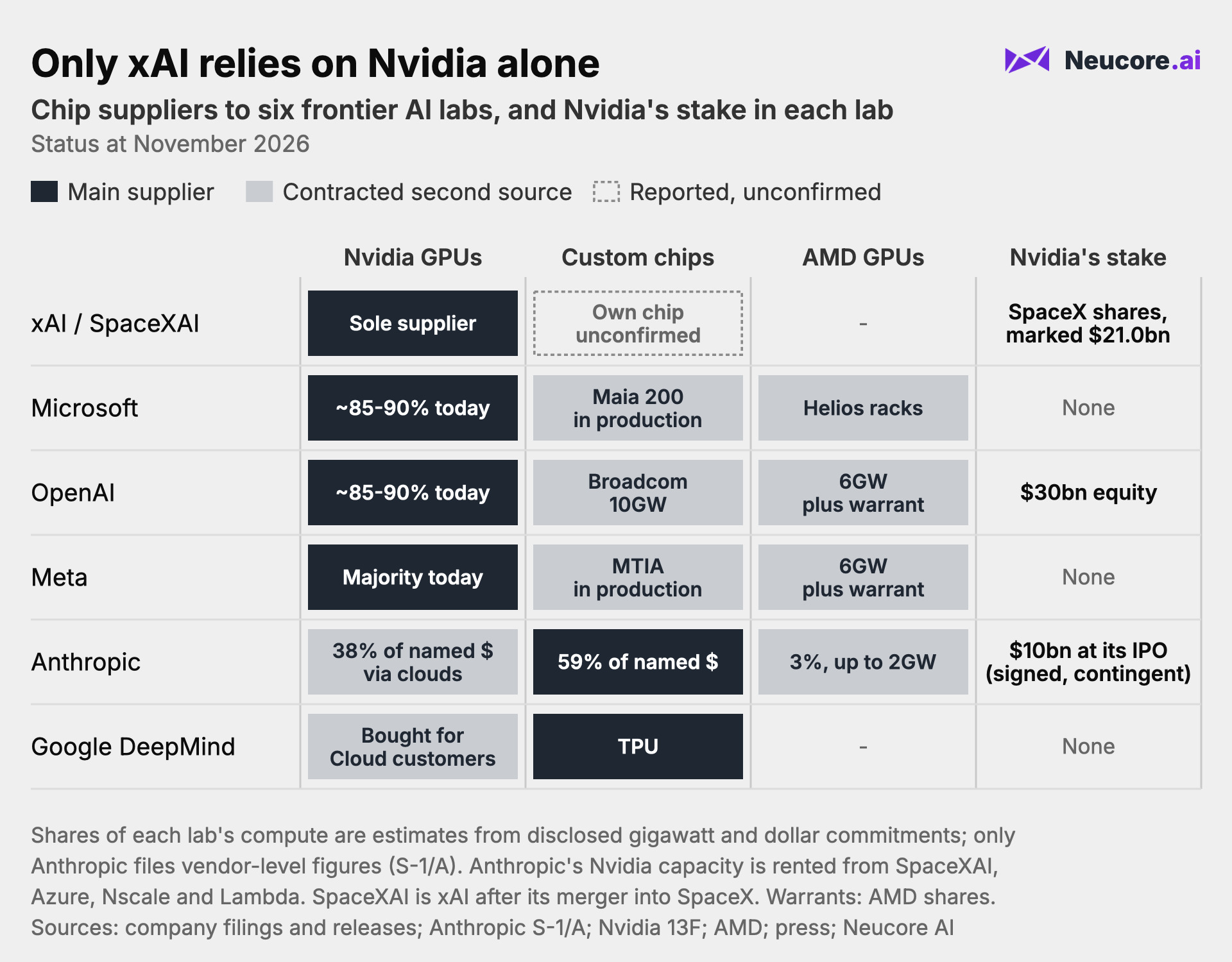
Of six frontier labs, only xAI runs on Nvidia alone. Every other lab has a second source under contract. OpenAI has 10GW of custom chips with Broadcom and 6GW of AMD GPUs; Meta has up to 6GW from AMD; Google runs Gemini on its own TPUs. Anthropic, the one lab that files vendor-level figures, puts about 59% of its named compute commitments on custom chips, 38% on Nvidia and 3% on AMD by our count, and its SpaceXAI contracts can be ended on 90 days’ notice from early 2027. Broadcom reports 30GW of custom-chip roadmaps with six customers; AMD says it has booked about 14GW.
What keeps a lab on Nvidia is now settled outside the chip: who gets allocation while supply is short, who gets financing for the data centre, who gets Nvidia as a shareholder. The stakes per customer are large. Huang put Vera Rubin at about $40bn of Nvidia revenue per gigawatt, against Broadcom’s $20–30bn for custom chips. CUDA still holds the long tail of enterprises, sovereign buyers and smaller clouds. At the top tier, commerce does the holding.
That commerce was Huang’s. The gigawatt pledges announced on stage, such as OpenAI’s 5GW, IREN’s 5GW and Thinking Machines’ 1GW, carry no Nvidia dollar; they were promises between chief executives, and they were converting at a discount before 12 November. The $100bn OpenAI letter of intent became a $30bn investment. The signed part carries over. The rate at which new commitments were written ran through his relationships. His successor inherits the same customers, second sources and rivals, without Huang’s relationships with their chief executives. That rate is the high-water mark the next chief executive will be measured against.
What history says
We looked at seven companies whose long-serving leader stepped down: Intel in 1998, Microsoft in 2000, Apple in 2011, Oracle in 2014, Cisco in 2015, TSMC in 2017 and Disney in 2020.

One year out, the results spread from 47% below the benchmark to 45% above it. Disney’s record stops at three years, because Iger returned as chief executive in November 2022. Of the six cases with a five-year reading, four had lagged, and the median relative return was −13%. Microsoft, the worst at five years, and Disney, the worst at three, both had a market shock inside the window: the dot-com bust and Covid.
The products mostly kept coming. Every inherited roadmap in the set eventually shipped, four of six on time. The two late ones, Intel’s Itanium and Oracle’s 12c release, were already slipping before the handover. The successors’ own resets came two to four years later.
None of these companies financed its customers on Nvidia’s scale. Cisco ran a customer-financing arm, but at a fraction of this size. For Nvidia that is the variable with no precedent.
Four ways it goes
Two questions decide the next few years. Does Nvidia keep the technical lead once the dated roadmap runs out? Does the ecosystem stay centred on Nvidia or split across suppliers?
- Lead held, ecosystem centred. The roadmap ships on its dates, GTC 2027 names the generation after Feynman, and capital goes back to shareholders through the $227bn left on the buyback. New guarantees slow and the existing book runs off on its terms. Signs: buybacks at the current pace, no new guarantees, a named successor generation at GTC in March 2027, gross margin recovering from the 71–72% guided for the January quarter.
- Lead held, ecosystem centred on the balance sheet. Nvidia keeps writing commitments at Huang’s rate. It exercises its option over about 3.8GW more at the Ohio site, available from fiscal 2029, signs more neocloud agreements, takes more equity in labs and runs more compute directly. This has the most upside and the most exposure to a credit cycle among Nvidia’s own customers. Signs: the Ohio option exercised, new neocloud agreements, new lab equity.
- Lead held, ecosystem fragmented. Nvidia keeps the best chip and the long tail. The top labs run two or three chip stacks, and Nvidia’s pricing power erodes at the margin. Much of this is already in signed contracts: the second-source deals shown in Chart C. Signs: Anthropic using its notice windows in 2027, OpenAI’s and Meta’s custom and AMD ramps arriving on time, price cuts or gross margin below the 72–73% guided for fiscal 2028.
- Lead eroded, ecosystem fragmented. Feynman slips or its custom memory goes wrong, custom chips reach parity, and a credit event among the neoclouds or labs turns guarantees into losses and equity marks into write-downs. It needs two failures at once. Signs: Rubin Ultra or Feynman re-dated, widening credit spreads at the neoclouds, a guarantee payment recognised.
Against these signs, the October quarter produced buybacks above the earlier pace, margin guidance unchanged, roadmap dates unchanged with nothing named after Feynman, and one new guarantee line. The leadership question sits across all four.
What it adds up to
The supply book to early 2029, the roadmap to 2028 and a $287bn ledger that is almost entirely signed were all written under Huang, and for now they run on their own momentum. The October quarter reflects that momentum; it is too early to show what the interim team adds. What lies beyond those dates was built by his supply deals, his deal-making and his willingness to lend Nvidia’s balance sheet to its customers. Until a permanent successor is named, the four paths above stay open.