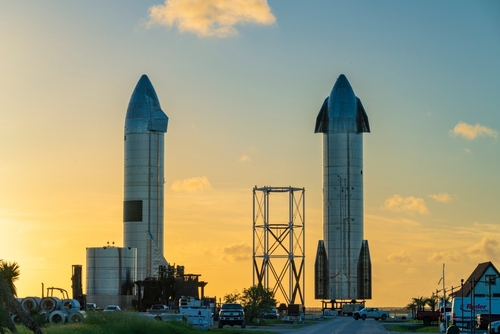
In 1602, the merchants of Amsterdam invented a new kind of company. The voyages they wanted to fund — to the Spice Islands, around the Cape of Good Hope, into seas whose maps were still being drawn — were too expensive for any single household and too risky for any single backer. So they divided the risk into transferable shares, and the Dutch East India Company became the first public corporation. The investors who bought those shares had no quarterly cash-flow projections and no segment-level EBITDA reconciliations. They had a thesis about the value of the spice trade, directors they trusted, and an acceptance that some of the ships would not come back. This was the original function of the market they participated in: to fund what no single hand could underwrite.
On May 20, 2026, that market received its most ambitious test in a generation. SpaceX filed Form S-1 with the U.S. Securities and Exchange Commission. Goldman Sachs leads an underwriting syndicate that includes essentially every bulge-bracket bank on Wall Street. The price range and share count are still blank — a preliminary prospectus — but the substance of the filing tells one of the more remarkable financial stories of the decade, and reopens the question Amsterdam answered four centuries ago. Can the equity market still finance voyages into the unknown?
Opening the hood.
SpaceX’s 2025 revenue was $18.7 billion, 2025 net loss was $4.9 billion, and Q1 2026 net loss was $4.3 billion — nearly matching the prior full year in a single quarter. Cash fell from $24.7 billion at year-end to $15.9 billion three months later. Long-term debt sits at $29.1 billion. Capex in 2025 ran $20.7 billion, with Q1 2026 already at $10.1 billion. By the conventional public-market screens — operating cash flow against capex, profitability, leverage — this is not a filing that should sail through any allocation committee.
Three further disclosures change the picture.
The first is a $20 billion unsecured bridge loan, agented by Goldman Sachs, dated March 2026, with a covenant that the proceeds of “a qualified initial public offering” must be applied to repay the bridge within six months. This is not an IPO of opportunity. It is an IPO of obligation. Whatever Elon Musk’s stated preferences about remaining private, the bridge made the decision for him.
The second is the basis of presentation. The financials are retrospectively combined to include xAI, acquired by SpaceX in February 2026, and X Holdings, acquired by xAI in March 2025. The entity going public is no longer a rocket company. It is a holding structure into which Musk has folded every one of his major bets except Tesla — launch, satellites, the social network, and the frontier AI lab. A cash-generative anchor is being used to carry the rest.
The third is the segment economics. Of the $20.7 billion in 2025 capex, $12.7 billion went to AI, $4.2 billion to Connectivity, and $3.8 billion to Space. Starlink alone produced $7.2 billion of Adjusted EBITDA — up from $3.8 billion a year earlier, on subscriber growth from 4.4 million to 8.9 million. Space produced $653 million, down from $1.15 billion, as Starship development consumed the Falcon launch business’s contribution. AI produced negative $1.24 billion. The cleanest summary of the entire S-1 is a single sentence: Starlink is paying for everything.
The bundle is the offering.
The bleak headline losses are not the symptom of a failing business. They are the cost of running three frontier businesses simultaneously, two of which are deep in multi-decade investment phases. The $12.7 billion of AI capex is the price of building the third frontier AI lab on earth — and the only one that owns its own data centres and compute infrastructure outright, while OpenAI rents from Microsoft and Anthropic rents from Amazon and Google. The $3.8 billion of Space capex is the development cost of a vehicle that, if it works as designed, replaces every existing launch system. The $7.2 billion of Starlink EBITDA is the load-bearing number that makes everything else possible. Strip Starlink out and list it alone — it would IPO at a valuation no growth-investor mandate could refuse. The trick of this offering is that you cannot buy Starlink without also buying the rocket program, the Mars mission, the orbital AI compute thesis, and the xAI burn. The bundle is the offering.
The dual-class structure puts the bundle permanently under Musk’s control. Class B common stock carries ten votes per share, and its holders, voting as a separate class, elect a majority of the board. Public Class A shareholders are buying economic exposure with effectively no governance recourse. The composition of the bundle, and the direction in which it travels, are set in perpetuity by the founder who assembled it.
A referendum on what the market has become.
This filing arrives at a moment when the equity market has spent decades drifting away from the job it was created for. Net equity issuance in the United States has been negative for most of the period since 2009 — the public market has become a venue for capital return through buybacks, not capital formation through new issuance. The IPOs that have happened have been overwhelmingly liquidity events for venture capital rather than capital raises for new ventures. The dominant institutional flow is passive. The dominant active discipline is quarterly earnings management. The result is that the most ambitious capital formation of the recent era — frontier AI labs, deep-tech defence, fusion startups, the entirety of SpaceX itself for the first twenty-four years of its existence — has happened predominantly in private markets. Public markets, in their current form, have largely lost the capacity to underwrite ventures whose payoff horizons exceed three to five years and whose intermediate financials look bleak by design.
The SpaceX use-of-proceeds language is specific to “the expansion of our AI compute infrastructure, enhancements to our launch infrastructure and launch vehicles, increases in the scale and capacity of our satellite constellations.” This is not standard IPO boilerplate. It is specific about exactly the kinds of long-horizon, uncertain-payoff investment that the modern public market has been trained to discount aggressively.
A market that prices SpaceX as a conventional growth company will arrive at one valuation. A market that prices it as what it actually is — a portfolio of moonshots subsidised by a single proven cash engine, governed by a single founder with an unmatched record on long-horizon technology bets, deploying capital into exactly the work the equity market was originally invented to enable — will arrive at a different one. The mechanics of how the deal prices and how it trades over its first months will be the first read on whether the public market still possesses the capacity to do its founding job.
The same question, but the stars are the destination.
In 1602, Amsterdam investors wrote cheques for ships that might never return, in exchange for the chance that one of them came home with the cargo of the century. In 2026, the institutional descendants of that exchange are being asked the same question — only the hull is now a Starship and the cargo is space-bound. From ocean-going to space-faring, the equity market that began as an ark for transoceanic risk is being offered the chance to become an ark for interplanetary risk. The stars are beckoning.
Note on data
All financial figures are sourced from Space Exploration Technologies Corp. Form S-1 filed May 20, 2026 (sec.gov/Archives/edgar/data/1181412/000162828026036936/). This article does not constitute investment advice. For prior Neucore analysis on the AI capex cycle that the SpaceX AI segment fits into, see The AI Capex Machine: When Does It Stop?.